Richard Florida, author of The Rise of the Creative Class was interviewed in Salon about cities that attract creative people: "[San Francisco] became very early on a kind of capitalism that recognizes that you don't have to have all this bullshit organizational, bureaucratic nonsense to be successful. San Francisco was a place where weird people could find a place...The best thing that happened to San Francisco was the damned NASDAQ collapse and the high-tech recession. That was San Francisco's saving grace." [via MeFi]
Spent the past couple of days in Lassen Volcanic National Park hiking and relaxing. It was great time, though the trail was often hidden from us by snow. The first hike was a day of map reading, terrain reading, tree-marker spotting, snow-pack climbing, twelve lakes, and patience. And you couldn't pick a better group of people to be lost in the woods with. The second day ended with a close-up view of a waterfall.

meg, preston, and pascal orienteering in Lassen
more>>
meg, preston, and pascal orienteering in Lassen
more>>
psst...blogroots is taking its first steps. We'll probably have an official launch next week sometime, but until then you can watch (and help!) the site get rolling.
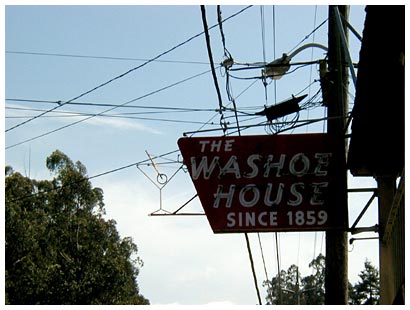
Washoe House sign near Sebastopol, CA
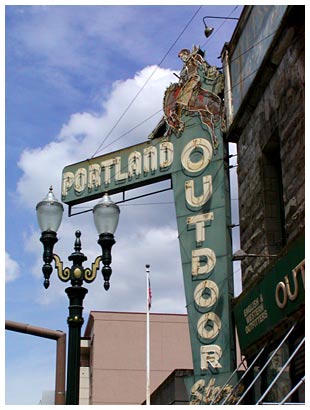
Portland Outdoor sign in (where else?) Portland, OR
More PR identity sketchiness reported by The Guardian in The fake persuaders: "Sometimes, in other words, real people have no idea that they are being managed by fake ones." [via MeFi] I'm not sure what a fake person is, but I know what the writer is getting it. It's all about honesty and disclosure.
New Weblog Bookwatch Feature : Focus Links
For every book on the Weblog Bookwatch there is a corresponding mentions page. These pages show all of the weblogs that have mentioned that particular book. The new feature: now each mention will have the option of being "focused" to a specific post. By clicking on "focus this link", you'll have the opportunity to put in the permalink location for the post that discusses that book. The link will then have a star next to it on the mention page to let people know it's referring to a specific post. The link will stand out, and the Weblog Bookwatch will be a little more useful for everyone. Instead of pointing to the general weblog URL, and having to search for the mention, people can find the relevant post instantly. It requires a little bit of copying and pasting, but those focused links will probably get a bit more traffic because they'll be more useful.
If used, focusing the links should also help differentiate between people discussing the book, and those who just have it listed in their sidebar reading list.
This feature is brand new and may have a few bugs to be worked out. If you notice anything odd, let me know. It works on the honor system, so if it's abused it'll probably go away. Hopefully we can cooperate to make it work. Thanks!
Update: To get a feel for how it works, check out the mentions page for "A New Kind of Science". I went through and focused the links for several of the weblogs.
For every book on the Weblog Bookwatch there is a corresponding mentions page. These pages show all of the weblogs that have mentioned that particular book. The new feature: now each mention will have the option of being "focused" to a specific post. By clicking on "focus this link", you'll have the opportunity to put in the permalink location for the post that discusses that book. The link will then have a star next to it on the mention page to let people know it's referring to a specific post. The link will stand out, and the Weblog Bookwatch will be a little more useful for everyone. Instead of pointing to the general weblog URL, and having to search for the mention, people can find the relevant post instantly. It requires a little bit of copying and pasting, but those focused links will probably get a bit more traffic because they'll be more useful.
If used, focusing the links should also help differentiate between people discussing the book, and those who just have it listed in their sidebar reading list.
This feature is brand new and may have a few bugs to be worked out. If you notice anything odd, let me know. It works on the honor system, so if it's abused it'll probably go away. Hopefully we can cooperate to make it work. Thanks!
Update: To get a feel for how it works, check out the mentions page for "A New Kind of Science". I went through and focused the links for several of the weblogs.
Argh! Driving back from Yosemite the other day we were listening to some marginal radio stations. Since then I can't get Lady by Little River Band out of my head. It's driving me insane. Anytime there's a quiet moment in my head I hear a little, "Look around you, look up here. Take time to make time, make time to be there." Or worse, the chorus. I'm hoping this post will help. Anything stuck in your head at the moment? (Maybe I can have a mental battle of catchy tunes until they all destroy each other.)
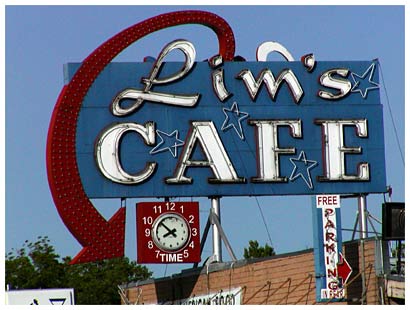
Lim's Cafe sign in Redding, CA
Douglas Rushkoff on writing: "As I see it, all writers - fiction and non-fiction - are like travel writers. We go to places that most people dont' have access to, and then write about them. Whether they are physical places, emotional places, or psychic spaces, we either have been blessed with access to them, or we are crazy enough to venture into them. Our only obligation as writers, is to report back what we've found, and to add as much or as little analysis and commentary as we feel is appropriate."
I'm co-writing a book about weblogs called We Blog: Publishing Online with Weblogs. (You can pre-order or add it to your wishlist at Amazon already.) I haven't mentioned it here yet, so it's about time. It has been great working on a project with Meg and Matt again.
And keep an eye on blogroots for more info.
And keep an eye on blogroots for more info.
Me and my RSS files are taking part in the <link>-a-thon.