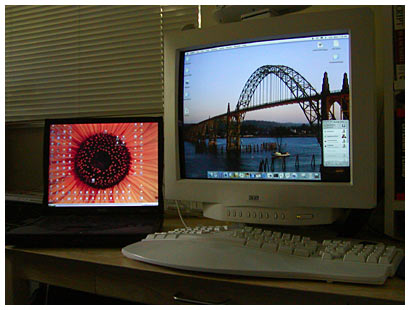
Oregon is freaking HOT

I didn't sign up for this. FTLOG, I had no idea Oregon would be this hot consistently. Luckily it looks like it's going to cool back down to the 80s in few days.

Continuing Amazon Ted Saga

More Amazon news: According to the Seattle paper it turns out Ted was not a PR-experiment fiction, but is a real life person. The only question that remains is why they yanked the plug on his blog so abruptly.

Amazon RSS Feed Builder

Amazon didn't really let people know how to add feeds to their newsreader so I whipped up a page that can get you started: Amazon RSS Feed Builder. You can build Book, DVD, or CD feeds with this little tool. Just choose a category or enter a keyword and you'll get the URL for the feed. Then you can copy the feed URL and paste it into your newsreader. If the RSS looks good (ie. has items), you should also get a preview of the feed so you can see what's in it. The feed builder hasn't been tested too much so let me know if you run into problems.

Here are some RSS feed URLs I built with this tool (that I'll be monitoring): Try it out: Amazon RSS Feed Builder.

Update: The feed preview is a bit sketchy—so even if it says there aren't any items, check the feed manually to see if that's true.

Hacking Amazon RSS

Matt notes that Amazon has embraced RSS syndication of its catalog. Matt also posted an example feed that lists books about weblogs. This is a great illustration of why Web Services are important.

Speed is key

To implement this new feature in the world before they had Web Services, a company like Amazon would have to focus some developers on putting together the RSS. This would involve special code to get the results from their database and "hard coding" those results as RSS. Any change in use would probably require new code, more developer time, etc. In the world with Amazon Web Services (AWS) though, they already have output in an XML format and a mechanism for transforming that XML (XSLT). All they needed to do to implement this feature was write a stylesheet to transform AWS responses into RSS. Instead of writing new code to accomplish a specific task, they can simply write a new stylesheet to fit their new task. And the stylesheet will work for almost all of the AWS methods available (Author Search, Director Search, Keyword Search, Category Listing [aka. Browse Node]...on and on). With a single stylesheet they've opened up their catalog to the thousands of people using RSS newsreaders.

So, how does it work? Check out the monster URL for the sample feed Matt posted:
The URL is just a standard public AWS query with a slight change. Instead of the normal f=xml in the URL, it's f=http://xml.amazon.com/xsl/xml-rss091.xsl. This tells AWS to use Amazon's RSS stylesheet to transform the results before sending them back. And once you see that it's using their standard AWS queries, you can use that to your advantage.

What's in it for me?

If you want to offer specific Amazon product feeds, and you want to get a kickback (ok, affiliate fee) when someone clicks the link through their newsreader and buys a product—just tweak this URL. Change t=webservices-20 to t=[your associates tag] and dev-t=amznRss to dev-t=[your developer key]. That's it! Nothing to install on your server, no code to write. The only work you have to do is encouraging people to add your URL with your variables to their newsreader. This economic incentive is how Amazon encourages people to use their system, and I'm amazed more companies aren't doing it.

As Matt pointed out, Amazon will make money with RSS. And thanks to their open platform—there's no reason you can't make some money too.

Blogathon Article

There's an article in the Oregonian about the upcoming Blogathon. I won't link to the online version of the article because the Oregonian has a severe usability problem. Every time I click on a "deep linked" article, I get hit with a splash page that says, "Help Us Serve You Better" and asks for my zip code, age, and gender.

OregonLive serving us all better

Saying that it "serves me better" doesn't seem to be accurate, though, because the content is not personalized to the information I put in. (I'm frequently an elderly woman from Ohio.) I don't think they're actually serving me better, I don't think they care about my experience at all—they're simply looking for demographic information. (Most likely so they can tell their Web advertisers who they'll be reaching—hmm, lots of elderly women from Ohio!) And in the process, they're getting in the way of how I want to use their site. To make it worse, once I enter the info I go to yet another splash page that is filled with disclaimers and legal warnings. (Tip: Never let your lawyers welcome people to your site.) By the third click I finally get the article I wanted to see—and it's covered with screaming, zooming, flash, animated advertising. Of course, most of the time I don't click through all of these pages. (And consequently, I don't see their ads. Which means they're loosing money.) Why don't newspaper sites get the Web? Anyway, if someone mirrors the Oregonian article I'll link to it. But I don't want you to go through the clicking hell.

Instead, search for "blogathon" at Google or Daypop and see what people who understand the Web are saying about it. Don't get me wrong, I'm glad blogathon is getting mainstream press. People outside the weblog community should know about it. It's a fun event for some very good causes, so definitely check it out. (And look into sponsoring some poor, tired, 24-hour blogging people if you have the means.)

Life in Roratonga

Life in Roratonga: "When we tell our new landlord that we'd like to move into her house, she slowly gets up from the garden she's tending to and asks us what day it is. Then she asks which month."

Beta Amazon hacks

O'Reilly put up some beta Amazon hacks from the book of the same name. These hacks haven't been through the entire editing process, so they're a little rough around the edges (hence, beta). Each hack (all separate PDFs) also has a complete table of contents, so you can get an idea of what's in the whole book. (Did I mention you can pre-order on Amazon? ;)

Tomatoes picture

tomatoes

Frisbee dog picture

mistimed jump
mistimed jump

AWS Round-up

An indpendent Amazon developer is keeping his eyes on the developer discussion board at Amazon and highlighting the good stuff on his site. [via the AWS Newsletter] This is cool, but it would be even better as a frequently updated weblog.

Service note: weblogs.com is down

weblogs.com hasn't updated since 11:45 this morning. Which means Weblog Bookwatch and ORblogs aren't updating properly. (And a bunch of other services around the Web, I bet.)

Niagra Falls

Meg has a great idea for revitalizing tourism to Niagra Falls. Another way to improve tourism would be scheduling "natural flow" days at different times of the year where they open the dam a bit and bring the water flow back to its pre-dam volume. It would be a spectacular sight to see. In fact, people are trying to restore the flow. (Though I'm not sure how actively, because that page is out of date.) They could also go the other way and have "no flow" days where they let people see the rocks underneath the falls. (They did this once for research.) Though both of these may take away from the fact that Niagra Falls is a "natural" wonder because people would see firsthand that we control the amount of water rushing over the edge. Of course the least desirable option is to let Pfizer rename the falls for millions of dollars. It's only a one-letter difference—changing the signs would be easy.
« Older posts  /  Newer posts »